Name Combiner
Combined Names for Baby & Couple
Use our free name combiner tool to blend two or more names into one unique one. Perfect for couple ship names, baby names, usernames, brands, and wedding hashtags. No signup, no data storing.
Word Combiner
Mix any two words into creative new ideas — perfect for middle and last name inspiration.
Couple Name Combiner
Generate cute, cool, or funny ship names for couples with our smart name masher.
Baby Name Combiner
Blend mom and dad's names to discover meaningful baby name options for boys or girls.
How the Name Combining Idea Came to Me?
Look, I have around three years of experience in name combination tools. I first started a name mixer site in 2023 with the focus of general name combining, but unfortunately, I was scammed by a partner and the site was taken from my hands. I then started a new site specifically for couples, baby names, and word combining in 2025, and that name combiner generator is now used by more than 10,000 people every month and is growing day by day.
Now you might wonder why I would create a new site if I already have one running successfully, so let me explain. When I was scammed with my first naming/name masher site, I just wanted to leave everything behind, or alternatively, start 2 or 3 more sites as a backup. I chose the second option and built these two sites in the same niche but with different styles and vibes.
The very first inspiration to mix names together, before 2023, came from my fiancée. We both wanted to merge our names, “IBRAHIM” and “SHINOGAI,” to honor our relationship, so I took the step into the name-blending tool niche.
I hope you will use our tools and take advantage of them. I also hope you will all support my fiancée and me by simply using the tool and sharing it with your family and friends. If you are curious about our second name combinator, check it out here.
What's a Name Combiner?
If you want to combine names for couples, you have come to the right place. A name combiner is a fun and easy naming tool that takes two or more words and mixes them together. People often ask, “what combined names called?” They are called a portmanteau, a hybrid name, or a mashup name.
Whether you want to create a nickname, a ship name, or a unique identity for a brand, our free name tool helps you do it in seconds. Our naming service helps you:
Merge names to create a single name.
Use it as a word combiner to combine words or merge words.
Create a name fusion or a fun name mashup.
Work with a name joiner to join two names.
This is one of the best name combiners because it acts as a name creator, name masher, and name mixer all in one. You do not need to struggle to mix names by yourself. Our online name combiner makes name blending and name merging simple.
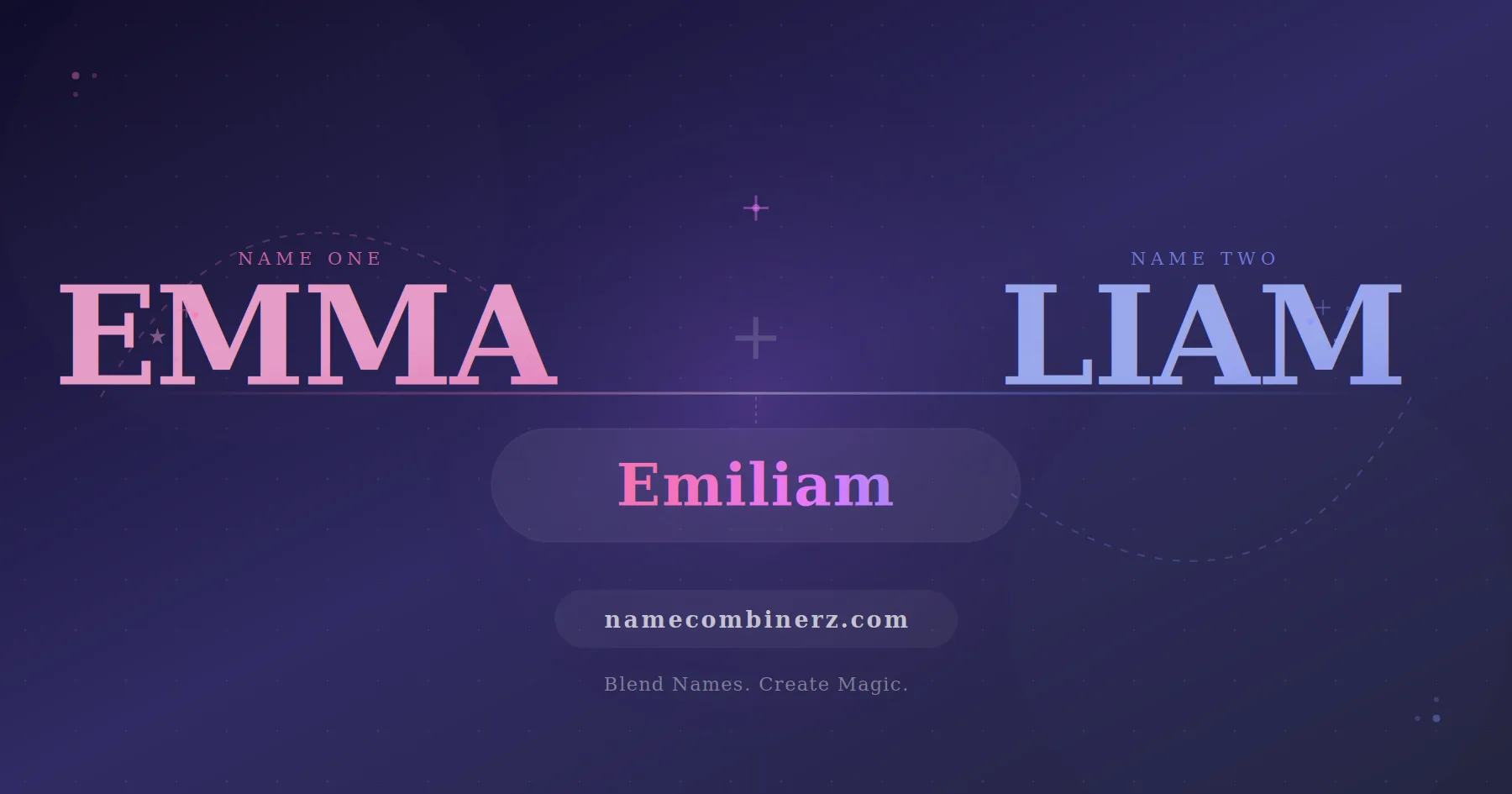
How Name Combiners Work?
In the old days, people had to use a pen and paper to brainstorm. That paper pen era made combining names a slow process. Today, we live in the AI era. Our tool uses AI technology and advanced name combining techniques to bring you unique combined names.
So, how does this naming calculator work? This system is a step up from the old school algorithm. When you type in your words and click the generate button, our tool begins to process name inputs. It instantly merges the inputs using AI naming and advanced algorithms in just a few seconds or milliseconds.
Here are the structural and formal techniques our name combiner uses to intelligently combine your names and words:
Syllable Blending & Syllable Mixing: The name combining system breaks names into syllables. It uses splitting names and syllable swapping or syllable alternation to make a single name.
Sound Blending & Phonetic Blending: To make sure you can easily pronounce the results, our name combining technology uses phonetic alternation and sound smoothing.
Letter Blending & Overlap Blending: By finding a shared sound, the algorithm uses letter pooling and separating letters to create natural-sounding name combinations.
Portmanteau Technique & Meshing Technique: Our name merging algorithms take the most appealing parts of each word and use a full fusion to craft a harmonious name.
This name flow takes only a short moment. Instead of a basic joining with manual rearranging on paper, our intelligent combining engine looks at the phonetic sound and syllable structure in various ways to generate the best output. This modern concept keeps the fun tradition of name mixing alive without the manual hassle.
How to Use Name Combiners?
Using our name mixer is very simple; there is no signup, no registration, and no account required. You do not have to share any personal information, email, or credit card. There is also no downloading required. This tool is completely free with no limits, meaning you have unlimited use at no cost, and we require no information from you to sign up!
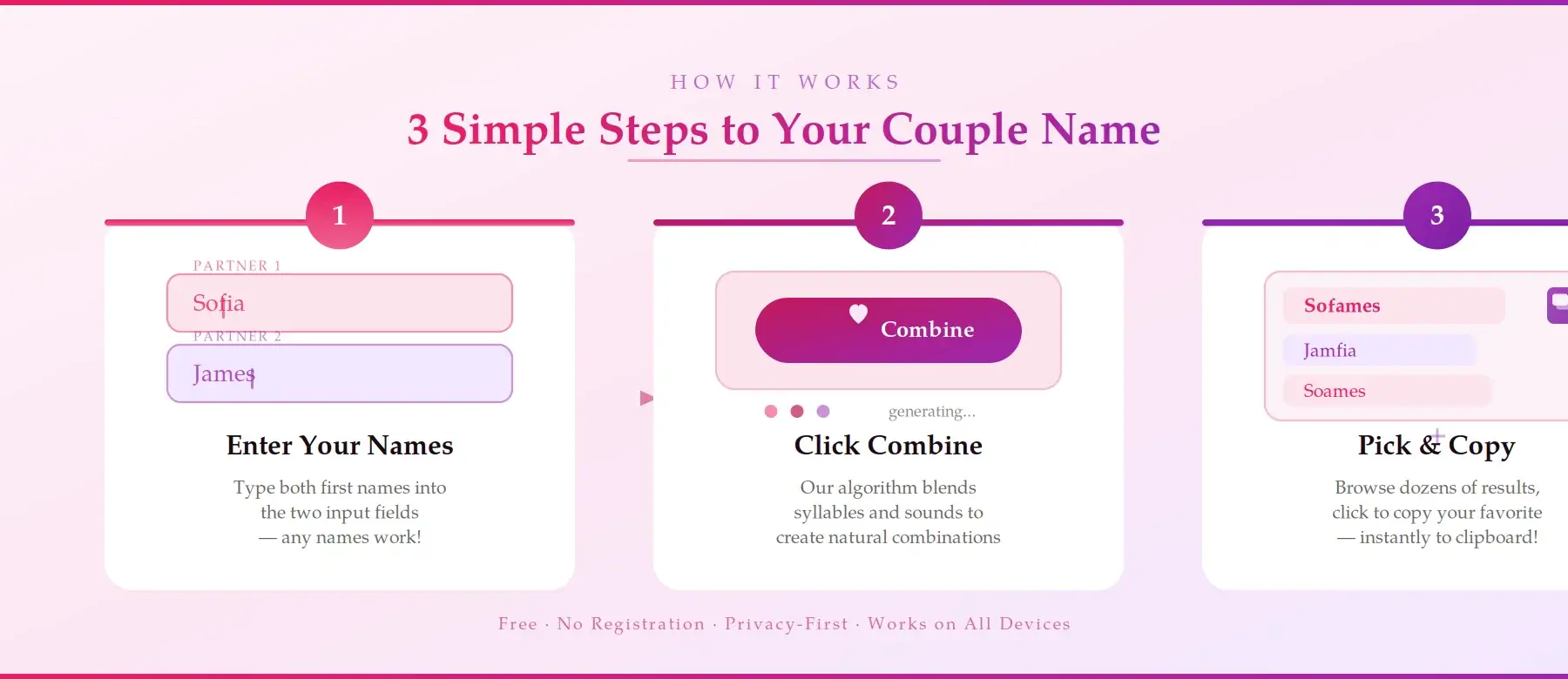
Here is a step-by-step guide on how to create your unique combined names:
Step 1: Input your names
First, visit our page, let’s you want to combine names for a couple.
Type names into the designated text boxes or fields.
Enter names like a first name and a second name. You can even select people and choose the number of people you want to mix.
Make sure your name input uses proper name characters without accidental spaces or strange punctuation.
Step 2: Generate the results
Click the generate button or the combine button.
Our tool will analyze names and generate a list of combined names in seconds.
You will see multiple options and usable names that are easy to pronounce.
Step 3: Save and manage your favorites
Look through the name results and name variations.
Click the star button next to your favorite ideas to add them to your name favorites or saved names list. Your list of saved names is easy to find.
If you want to see more mixed names, click again on the ” combine names button to get fresh variations. Your saved ideas intact will remain safe in the list.
Use the copy button or the copy name option to copy a combined name to your clipboard, then paste it anywhere.
You can also click the download button to save your favorite combined names as a text file.
- A great thing about our tool is that you can pronounce the name combination to check its awkward sound.
How to Choose the Right Combined Name?
When you have a long list of combination ideas, you might feel a bit confused about how to choose combined name options. Finding the right combined name takes a little bit of thought. Whether you are naming a company, a brand, a pet dog, or creating an Instagram handle, here is how to find the perfect name that matches vibe profiles.
1. Test the Sound and Flow
Make sure you can easily pronounce the combined name.
Do a quick test by asking friends or a loved one to call name options out loud before sharing social media posts with friends.
Check the name writing style. Try a name swap or change the name order to see if swapping the words makes the name flow better. If the order is confusing, swapping them might reveal the best option.
2. Check the Meaning and Background
Do some name research to make sure the word is meaningful.
Check if it has a negative meaning in other languages. Since different languages and traditions have different word meanings, keeping your identity positive is very important. Ensure your partner loves the meaning too!
3. Verify Availability Online
Before finalizing name choices for social profiles, gaming profiles, or a site domain, checking name availability is vital:
| Platform / Use Case | What to Check |
| Social Media | Search for a free TikTok or Instagram public username. |
| Website | Is the domain available, or is it taken? |
| Business / Brand | Do a brand name search trademarked check to avoid legal issues. |
Using a thorough combined name search prevents future headaches. Once you find a name that is not trademarked and has social handles open, you are ready to claim your new name!
Name Combiner vs. Doing It Manually
Why use an online tool instead of making names manually? Trying to combine names manually with pen and paper is gone. In that old tradition, you had to use basic joining and combine math in your head.
Often, this manual concept leads to weird, irrelevant, or messy names. You might end up with an awkward combination that does not make sense. It causes unnecessary pressure and stress when you are trying to combine names together.
Our modern name-combining tools are like having a naming expert in your pocket. This is why name combiners are so powerful:
Speed and Efficiency: Our advanced name merging algorithms give you quick results in a seamless way.
Better Quality: Instead of weird names, our name mixer algorithm uses smart techniques to generate highly relevant combinations.
Easy to Use: Our tool offers a user-friendly interface that is accessible to everyone.
Common Mistakes When Combining Names
When people combine names, they often fall into a few common traps. To help you avoid these name blending mistakes I have listed the top errors to watch out for:
Using Full Legal Names: Using massive, long names instead of shortened name or nicknames leads to a clunky blend. Try using middle names or shorter parts of the names for smoother results.
Ignoring the Name Flow: If you do not test how a combined name sounds, you might end up with weird names that are hard to pronounce. A good name must sound good, be easy to say, and be easy to remember.
Forgetting to Swap the Order: Sometimes, people get stuck on one order. Try swapping names or putting them in reverse order to avoid a confusing or boring name outcome.
Over-complicating with Heavy Blending: Doing too much combining math or heavy blending can scramble the original letters too much, making the final word unrecognizable.
Not Checking Other Languages: Your name might sound perfect in English, but it could have an unexpected negative meaning in Hindi, Urdu, Arabic, Spanish, or Korean. Always search your combinations across multiple languages.
Ignoring Name Length and Domain Potential: If you want to use the name online, a long name length makes it hard remember. Avoid generic nicknames that is already taken or lacks a clear trademark path.
By avoiding these irrelevant name pitfalls, you will easily create a name that stands out!
Tips for Creating Perfect Name Combinations
Want to get the most out of your naming process? Here are some expert name-combining tips to help you make perfect name combinations:
Use Creative Blending Techniques
Cut and Attach: Try to cut the first half of one name and the second half of the other, then attach the halves.
Syllable Mixing: Use splitting names into syllables and rearranging them. Combining a two-syllable word with a three-syllable word often gives smoother results.
Blend Sounds and Letters: Use structural techniques to blend letters, sounds, and syllables based on how they start and end to make the phonetic sound beautiful.
Play with Name Order
Try swapping names, using a reverse order, flipping names, or changing the swap order to see how the output changes.
While you can use short names, medium names, or long names, choosing shorter combined names is usually best. A shorter name length ensures it is easy to say and easy to remember for the long term.
Combine Names with Keywords
If you are building a brand, you can combine your name with words from your industry:
Try keywords blending by mixing a personal name with an industry word (like “Clinic” + “eye care” to blend into a unique business name).
Add interesting words or create pun-based hashtags for social media.
Verify Your Perfect Blend
Once you think you have a perfectly combined name, do some quick name research. Check the name flow, domain, and trademark to make sure your perfect blend is safe to use. Take your time brainstorming combinations to find a truly meaningful name!
10 Features That Differentiate Us
What makes our name combiner tool stand out from other name combining tools? Here are 10 unique features designed to give you a seamless and convenient user experience:
Completely Free with No Limits: Our name combiner free site has no signup rules. You can use it on all devices with unlimited use.
Multi-Name Support: You can combine 2 names, combine 3 names, or combine 4 names. Our tool can combine up to 12 names into one.
Advanced Customization Filters: Easily customize results with our intuitive controls. Set a minimum length or maximum length to get a short, medium, or long combined name.
Flexible Case Style and Separators: Match your creative vision by choosing a case style like uppercase, lowercase, normal case, or capitalize. You can also add a separator like a hyphen, an underscore, or a custom separator.
Smart Styles: Our name combiner generator offers a smart blend mode. You can choose a brand style, cute style, modern startup, luxury style, celebrity style, romantic style, or stylish style!
Smart Blending and Initials Mode: Experience deep phonetic blending or use our initials mode to generate highly usable names that are easy to pronounce with a built-in pronunciation feature.
Multi-Language Capabilities: Our name merger is built to support multiple languages. With built-in cultural filters and personalized outputs, you can mix names in Hindi, Urdu, Spanish, and Chinese to get perfect matches.
Easy Saving and Exporting: Click the star button to add names to your favorites or saved list. You can save combined names for future use, export names, or download text file options with a single click.
Quick Reshuffle: If you want more unique combinations, try adding your names in reverse or add some other alphabet or word with it to get unique monikers.
10 Powerful Reasons to Use Name Combiner Services
Why should you use an online name combining service? Our free name tool is built for many different name purposes and name uses.
Here are 10 powerful reasons to use our naming tool:
For Couples and Lovebirds: Create a cute relationship nickname or a couple nickname to show your relationship. It adds deep emotion, sentimental value, and meaning to your love life because husband-wife name combinations are a proven way to increase love.
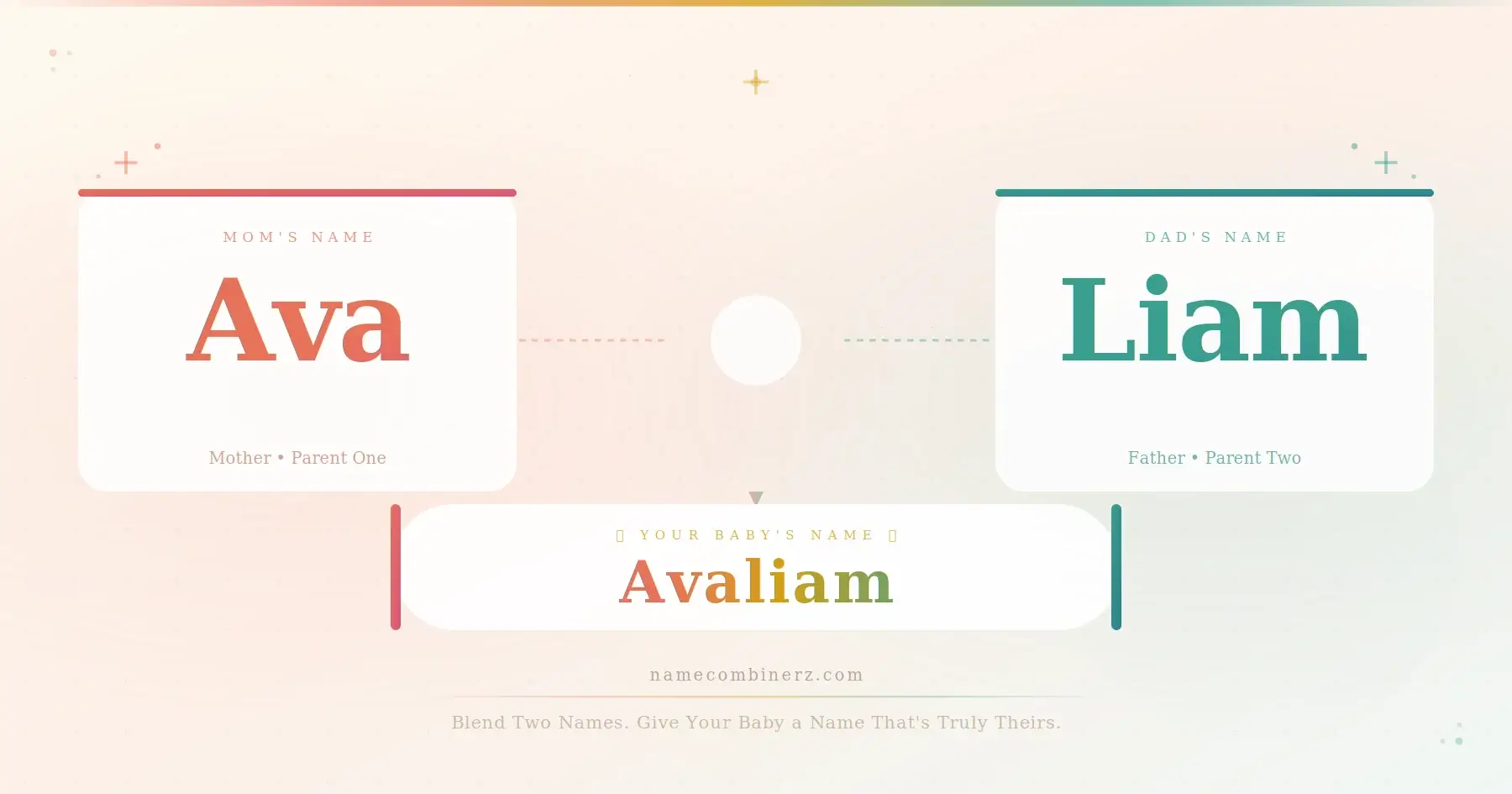
For New Parents: Easily find a baby name or a baby name combination by mixing the mother’s name and the father’s name. It helps families build a cohesive identity using boy-girl names.
For Best Friends (BFF): For best friends or a BFF, combine the best friend’s name to make a fun matching nickname for group chats, shared bios, or PUBG account.
For Writers and Gamers: If you write fanfiction, play role-playing games, or need character names, our tool helps you generate names for these purposes too.
For Brand Names & Small Business Owners: Create unique brand names, product names, brand identities, and a business name by having two words mixed together.
For Social Media Couples: Set up a joint account or manage social media accounts with a fun, unique name that represents an inseparable couple like a celebrity couple.
For Families and Surnames: Mix three names or create a unique family name that blends different heritages.
For Fun and Creative Projects: Need unique WiFi password names, a tattoo name, or some practically useful names? Our name mixing tool is fun, engaging, giving various combinations for your creative projects.
Wedding Hashtags: You can use our tool to create stylish and creative wedding hashtags for your big day.
- Pet Names: If you have a pet like a cat, dog, or parrot, you can mix any two names or words to create a unique name for your pet too.
Whether for personal use or professional branding, you can combine words or mix two names to get the best creative and unique options without any hassle.
5 Smart Algorithms Powering Our Name Mixer
Our name combiner does not just randomly mash letters together; instead, our tool utilizes strategic techniques and name generation technology to create beautiful names.
Here are the 5 smart name combining algorithms and name merging algorithms we use in our name combiners:
| Algorithm Name | How It Works | Why It’s Great |
| 1. Syllable Blending & Syllable Mixing | Uses splitting names into syllables, followed by syllable swapping or syllable alternation. | Creates very natural-sounding combinations that flow well. |
| 2. Phonetic Blending & Sound Blending | Focuses on the phonetic sound of words. Uses phonetic alternation and sound smoothing. | Ensures the harmonious name is easy to say out loud. |
| 3. Overlap Blending & Letter Blending | Finds a shared sound between names. Uses letter pooling and separating letters. | Blends names in various ways so they look like one natural word. |
| 4. Portmanteau & Meshing Technique | Uses a portmanteau technique for a full fusion of the most appealing parts of the names. | Excellent for joining names like a maiden name and a spouse‘s name. |
| 5. Structural Techniques & Formal Techniques | Uses prefixing (adding prefixes), middle name migration, hyphenation (using a dash or ampersand), and creating compounds. | Perfect for formal merging or blending words into clean outputs. |
Multi-Language Name Combining
The world is beautiful because of its many languages and traditions. That is why our tool is designed with strong multi language capabilities to support multiple languages. Whether you speak English, Hindi, Urdu, Spanish, Chinese, Arabic, or Korean, you can easily combine names or words to create a unique combined moniker.
To help you find a deep, meaningful name and avoid a negative meaning in other languages. This is perfect for global brands hoping to launch internationally or couples following local marriage traditions.
From modern pop culture trends to traditional roots, our multi language name combining engine helps you merge words across cultures while keeping your identity intact.
Name Combiner Styles Explained
Everyone has a unique creative vision. Because of this, our tool offers various name combiner styles to help you get a one of a kind result. You can customize the name output using different blending methods and name patterns to match your preferred aesthetic.
Customize Your Structure
Case Style: You can set your name case to normal case, uppercase, lowercase, or capitalize.
Separator: Choose a clean separator like a hyphen, an underscore, or even a custom separator to split your portmanteau combinations.
Name Suffix: Add a popular suffix to the end of your name. Easily add ify, add ly, add io, add verse, or add hub to make it sound like a modern company.
Choose Your Style Profile
Our name combiner uses a smart name algorithm to match your desired personality:
| Style Option | What It’s For | Example Vibe |
| Brand Style / Modern Startup | Business names and professional brand identity | Tech-focused, sleek, and memorable |
| Luxury Style | High-end, elegant names | Sophisticated and smooth |
| Cute Style | Adorable, sweet nicknames | Cute, pretty nickname, or pet name |
| Celebrity Style / Romantic Style | High-profile couples and relationships | Captures name, emotions, and name relationship |
| Stylish Style | Cool, trendy, stylish names or a stylish nickname | Modern, bold, and unique |
Control Your Combination Length
You can set your combination length to find the perfect size:
Short combinations / short combined name
Medium combinations / medium combined name
Long combinations / long combined name
Whether you need fantasy names, funny name ideas, or complex multi-name fusions, our name mixing tools offer endless name options. It merges names and words using full fusion and sound smoothing to give you a usable, pronounceable name.
Is it Safe to Use these Tools?
When you use a free name combining tool, you might wonder about your safety and privacy. We want to assure you that using our name combiner tool is completely safe and secure.
We prioritize your privacy and safety above everything else. Here is how our free name tool keeps your entered information and data secure:
No Personal Info Required: There is no account creation, no signup, and no registration required to visit our site. We ask for no personal information, no email, no credit card, and no downloading of any software.
Safe Server Processing: When our server processes names, it does so instantly. Our online name tool never stores your user information or name data for long-term use. In fact, our server regularly purges all inputting name inputs to guarantee total confidentiality.
Our name combiner free site is designed to be a naming utility that provides a safe, fun, and secure experience every time you visit.
Final Thoughts on Name Generator
That is the whole point of the name combiner tool, it quickly combines multiple names for babies, couples, businesses etc otherwise name mixing process takes a lot of guessing and time.
Our name generator finds where two names naturally overlap and turns that into something pronounceable and unique.
Enter your names, whether two or more, pick a style, and use the tool features, tap on the combine names button, and see what you get. Now, just finalize a combined name for your desired purpose.
Frequently Asked Questions
What is a couple name combiner?
It’s a fun little tool I built to blend you and your partner’s names into a single, catchy nickname like “Brangelina.”
What is it called when you combine two names?
It’s usually referred to as a portmanteau, a blend name, or what the internet affectionately calls a “ship name.”
How do you combine two names together?
My tool automatically splits both names into syllables and blends the vowels and consonants to find the smoothest combination.
What is a couple name combiner used for?
People mostly use it to create combined couple name, ship name, wedding hashtags, unique social media handles, or cute nicknames for their relationship.
Is a name combiner free to use?
Yes, I keep this tool completely free to use, and you don’t need to sign up or enter any payment info.
How many name combinations can I generate?
There are no limits here, you can hit the generate button as many times as you like to get different variations.
Can I combine more than two names?
Yes, I designed the system to let you plug in multiple names if you want to create family blends or group nicknames.
Are my combined names saved or stored?
No, your privacy is important to me, so everything is processed on the fly and I never store or track your inputs.
Does it work with non-English names?
Yes, the blending logic focuses on phonetic patterns, meaning it works great with names from various languages and scripts.
What is a baby name combiner?
It’s a version of my tool specifically tweaked to blend parents’ first names to help come up with unique baby name ideas.
How do you combine two family names for a baby name?
You just enter both surnames, and the tool will slice and dice them to generate a brand new, meaningful hybrid last name.
Is this tool suitable for naming twins or triplets?
Definitely, since it outputs a whole list of balanced name variations, you can easily find sibling names that sound great together.
Can I use this tool to generate baby names?
Yes, it’s a really popular way for parents to brainstorm unique, personalized names by merging elements of their own.
Can this tool be used to create character names?
Yes, many writers and gamers use it to blend fictional concepts or real names for their stories and characters.
Can I use this tool for business name ideas?
Absolutely, you can type in key industry words or founder names to generate a unique, memorable brand name.
Can I use this to combine names for couple nicknames or social media?
Yes, that is actually the most common way people use it, to stand out with a custom handle on Instagram or TikTok.
How does the AI generate the combined names?
Rather than random mixing, it uses phonetic rules to analyze syllables and match consonant-vowel transitions for a natural sound.
What is the character limit for each input name?
I’ve set a practical limit of 15 characters per name to ensure the generated blends remain readable and catchy.
Are there any additional tools to complement the Name Combiner?
Yes, I’ve added a nickname generator and a name meanings lookup on this site to help you narrow down your favorite options.