Selfie, doomscroll, and mansplain all sounded odd once. Now they’re just words.
That’s what a neologism is: a new word, phrase, or a new meaning grafted onto an older one. They show up when people need to name something, a behavior, a feeling, a thing that didn’t exist yet.
They’re worth paying attention to because they track what’s actually happening. New technology, new frustrations, new ways people spend their time. Language catches up eventually.
Neologism definition and meaning, explained simply
A neologism is a word or phrase that is new to a language, or a familiar word used in a fresh way. It’s not simply an obscure word. It has to feel new in real use. According to Merriam-Webster’s definition of neologism, the term covers a new word, usage, or expression.
The word itself came into English through French. Its deeper roots are Greek, from parts that mean “new” and “word.”
Some neologisms stick because people need them. Others vanish because they never move beyond a small group or a short trend.
When does a new word count as a real neologism?
A made-up word doesn’t become a neologism the moment one person says it. It becomes one when other people start using it too.
You can spot that change in a few practical ways. The word appears in conversations, news stories, social posts, podcasts, and search results. After that, dictionary editors may start tracking it.
A neologism is new enough that people notice it, but common enough that it travels.
Dictionary status helps, but it isn’t the starting line. Real use comes first. The dictionary often shows that a word lasted long enough to matter.
Checkout our Word Combiner tool.
How neologisms are created in everyday language
English makes new words the way a busy kitchen makes leftovers into lunch. It combines, trims, repurposes, and renames. That happens fast because people want short words for new things.
Many new terms come from patterns readers already know. The Blue Book’s overview of neologisms points to common routes such as new combinations, abbreviations, and new meanings. Those patterns matter because they make fresh words easy to remember.
Blends, acronyms, and compounds
A blend mixes parts of two words. “Brunch” joins breakfast and lunch, while “smog” blends smoke and fog.
An acronym forms from initial letters. “Laser” began as shorthand for a longer technical phrase, then became an everyday word.
A compound joins whole words. “Smartphone” is a clear example because it names a new object with familiar pieces.
People also build neologisms with prefixes and suffixes. Words like “unfriend” or “microblog” feel easy to grasp because the parts already carry meaning.
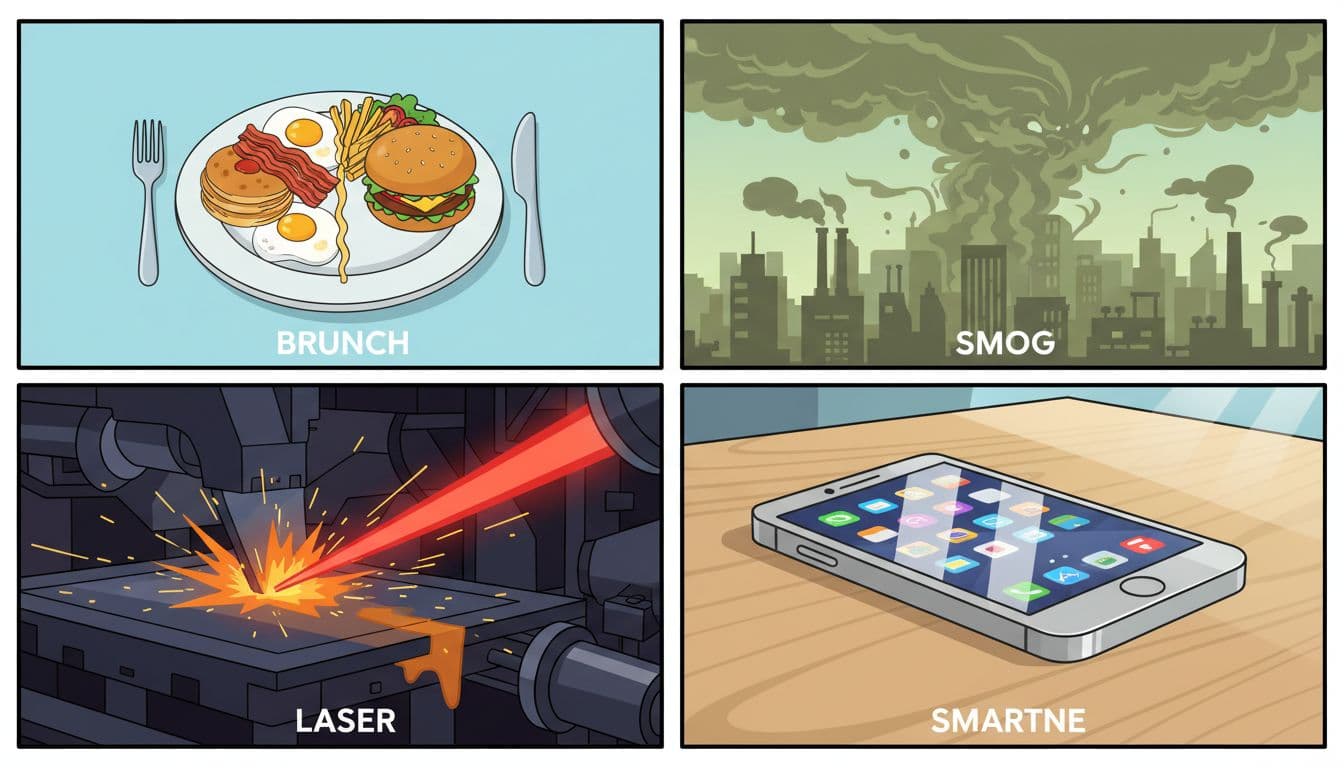
These forms catch on quickly because they save time. If a word is short, clear, and useful, it has a better shot at staying.
Old words can get new meanings too
Not every neologism is brand-new. Sometimes an old word gets reassigned.
Take “cloud.” It once pointed mainly to the sky. In tech, it now also means remote online storage and services. “Stream” used to mean flowing water first. Now it also means sending audio or video over the internet.
That kind of shift is common online. A familiar word feels less strange than a fully invented one, so people adopt it faster.
Common neologism examples, from classic words to internet slang
The easiest way to understand neologisms is to see them in the wild. Some are old enough to feel settled. Others still have that new-word smell.
Older neologisms that became normal words
“Nerd” was once a novelty word, then it became a standard label for a certain kind of person. “Factoid” started as a term for something that looks like a fact but may not be true. Many people now use it more loosely for any small fact.
“Boycott” has a striking history. It came from the name of Charles Boycott, an Irish land agent people refused to deal with in the 1880s. His name turned into a common verb.
“Selfie” is more recent, but it already feels settled. It spread because smartphones put front-facing cameras in everyone’s pocket. “Smog” followed a different path. It filled a need for a compact name for dirty, smoky fog.
These examples show a simple truth. Plenty of normal words were once the odd new kid in the sentence.
Recent neologisms shaped by social media and AI
Online life keeps producing new vocabulary at high speed. As of April 2026, dictionary blogs are still tracking AI-heavy coinages, including terms listed in Cambridge’s 2026 new words blog, which shows how fast fresh language can spread.
“Doomscroll” means scrolling through bad news for too long. It reflects the pull of endless feeds and constant alerts.
“Brainrot” describes the feeling that too much low-value internet content has melted your attention. Usually, it’s half joke and half complaint.
“Vibe check” means a quick read of a person’s mood, energy, or social fit. The phrase caught on because it packs a fuzzy social judgment into two simple words.
“Promptjacking” refers to hijacking or manipulating prompts in AI systems. That term grew out of the boom in public AI tools and the new risks around them.
“Goblin mode” describes messy, shameless, comfort-first behavior. It stuck because people liked having a funny label for acting a little feral at home or online.

Some of these terms may last for years. Others may fade with the trend that created them.
Why neologisms matter, and why some survive while others disappear
New words matter because they name things older language can’t name well enough. That includes tools, habits, moods, identities, and social trends. Without fresh terms, people have to use long explanations every time.
Some neologisms survive because they fill a real gap. Others win because they’re catchy, short, and easy to say. Repetition helps too. A word spreads faster when people see it in memes, news stories, classrooms, and group chats.
Still, plenty disappear. A term may be too niche, too confusing, or tied to a short-lived joke. If the trend dies, the word often goes with it.
How dictionaries decide whether a new word has staying power
Dictionaries usually don’t rush. Editors look for broad use across many sources and over time.
That means a word needs more than hype. It has to appear in enough writing and speech, in enough places, for long enough, to prove it isn’t a passing blip.
Conclusion
A neologism is a new word, phrase, or meaning that enters use because something changed, new technology, a cultural shift, a behavior that finally got a name.
They turn up everywhere once you’re looking. Apps, headlines, classrooms, group chats. Most of them stop sounding new within a year.