Compound words are everywhere in English. Sunflower, ice cream, toothbrush, you use them constantly without registering them as anything special.
Two or more words join to make one new word or concept. Sometimes the meaning follows directly from the parts, sometimes it doesn’t. There are three main types, and they’re not hard to keep straight.
The simple meaning of compound words
A compound word is made by joining smaller words into one unit of meaning. As Britannica explains, the result functions as a single word, even when the spelling style changes. So pancake, sunflower, and toothbrush are not random pairs. Each one names one thing.
This matters because the new word often means more than the parts by themselves. A toothbrush is not any brush and any tooth. It’s one object with one job.
How the meaning changes when words combine
The meaning can shift in a simple way or a surprising one. A classroom is not just any class in any room. It’s a room used for teaching. A pancake is not a pan and a cake sitting side by side. It’s a flat food with its own name.
Sometimes the new meaning stays close to the original words. A mailbox is a box for mail. Other times, the link is looser. A butterfly has nothing to do with butter.
If two words create one clear idea, you may be looking at a compound word.
A quick way to tell a compound word from a phrase
A phrase has separate words that keep separate jobs. A compound word acts like one idea. Compare black bird with blackbird. The first can mean any bird that is black. The second names a specific kind of bird.
Spelling alone doesn’t settle it, because compounds can appear as one word, two words, or a hyphenated form. Meaning does the heavy lifting. If you want to compare compounds with blended words such as portmanteaus, this word combiner tool shows a different pattern, where pieces of words merge into something new.
The three main kinds of compound words
English usually writes compound words in three forms. Once you know them, they become much easier to spot.
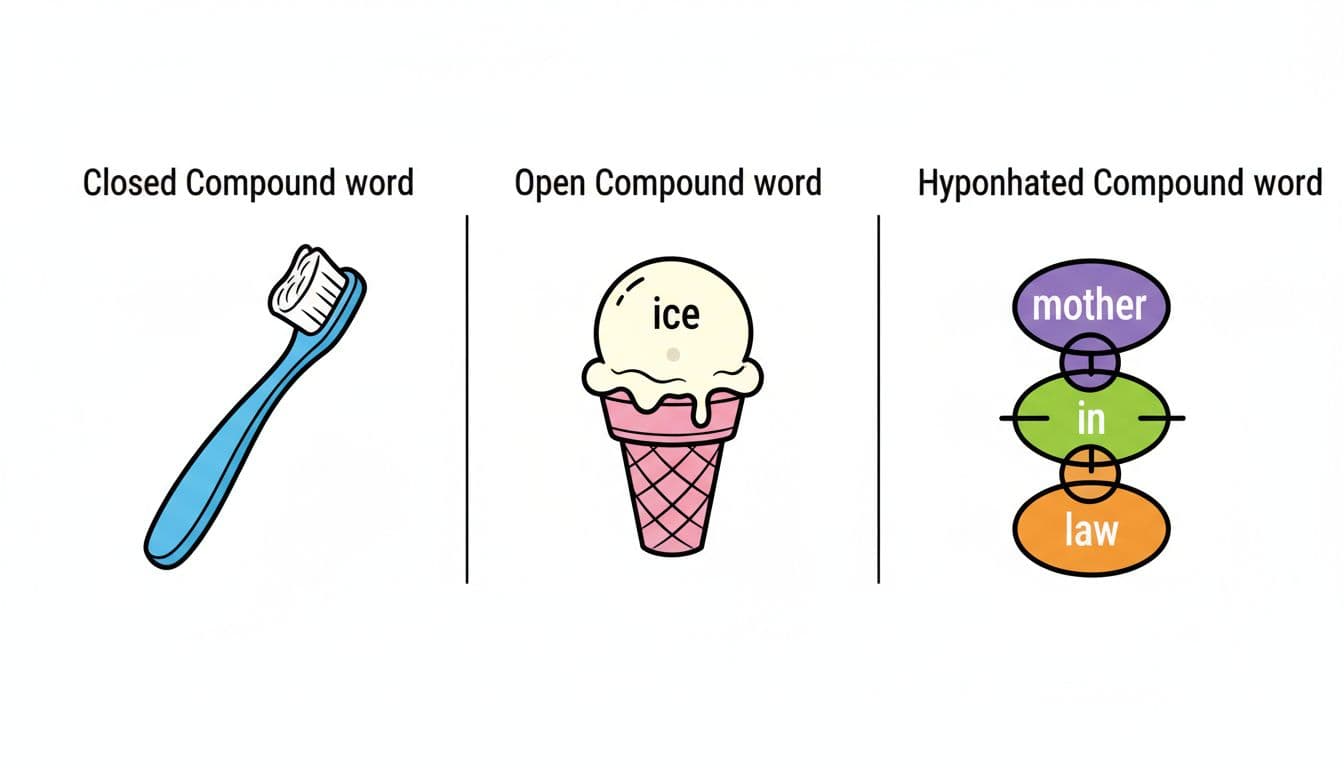
Closed compound words written as one word
Closed compounds have no space and no hyphen. They look like regular single words, which is why many readers stop noticing they were ever built from two parts. Common examples include bedroom, football, rainbow, mailbox, and toothbrush.
These often feel the easiest because they look settled. Once a closed compound becomes common, people tend to treat it like any other word in the dictionary.
Open compound words written as two separate words
Open compounds use a space, but they still express one idea. Examples include ice cream, high school, post office, full moon, and living room. That spacing can fool readers, because the words look separate even when the meaning is shared.
Still, context helps. When someone says high school, you understand one type of school, not two unrelated words standing next to each other.
Hyphenated compound words connected with a hyphen
Hyphenated compounds use a hyphen to tie the parts together. You see this in words like mother-in-law, long-term, well-known, and four-year-old. The hyphen signals that the parts belong together.
This style often helps before a noun. For example, a well-known actor is clearer than well known actor. In many cases, the hyphen prevents readers from taking the words apart too soon.
Compound word examples you hear every day
Compound words are not rare grammar terms. They live in kitchens, classrooms, sports, and daily routines.

Common compound nouns, verbs, and adjectives
Many compounds are nouns. You carry a notebook, visit a playground, and check your mailbox. English also uses compound verbs, such as babysit and double-check. In adjectives, you get forms like long-term and well-known.
These words make more sense in real sentences. “I left my notebook on the desk” sounds natural. “Please double-check your answer” does too. Cambridge has a helpful guide to compound nouns, and it shows how common these forms are in everyday English.
Easy examples kids and English learners can remember
Some examples stick right away because they connect to things you already know. Sunflower, breakfast, hot dog, classroom, and butterfly are easy starting points. A child can picture them. An English learner can hear them often.
A few are literal, like classroom. Others need memory more than logic, like butterfly. That mix is normal. It also explains why compound words help build vocabulary so well. They connect old words to new meanings.
How to recognize and use compound words correctly
The first step is to look for one shared meaning. Then check how the word behaves in a sentence. If the two parts act like one unit, you likely have a compound. Spelling can vary, though, and that is where many writers hesitate.
When hyphens help make the meaning clear
Hyphens often matter most in compound adjectives before nouns. Compare small business owner with small-business owner. The first could mean an owner who is small, or an owner of a small business. The second clearly means a person who owns a small business.
That tiny mark can save a sentence from confusion. So when a description comes before a noun, pause and see if the words need to stay linked.
Why some compound words change over time
English does not freeze compound spellings forever. Some begin as open compounds, move into hyphenated form, and later become closed. That shift is normal. Style guides and dictionaries track usage, but they do not always agree at the same speed.
For that reason, it helps to check a current reference, such as Merriam-Webster’s guide to compound word spelling. Recent English also keeps adding fresh compounds. Terms like brain rot and doomscrolling show how quickly new combinations enter daily language.
Conclusion
Compound words are built from smaller words but land as a single unit with their own meaning. Some are closed, some open, some hyphenated, different looks, same job.
Once you start noticing them, they show up constantly. Toothbrush, classroom, plenty of newer words you use online. The pattern is always the same.